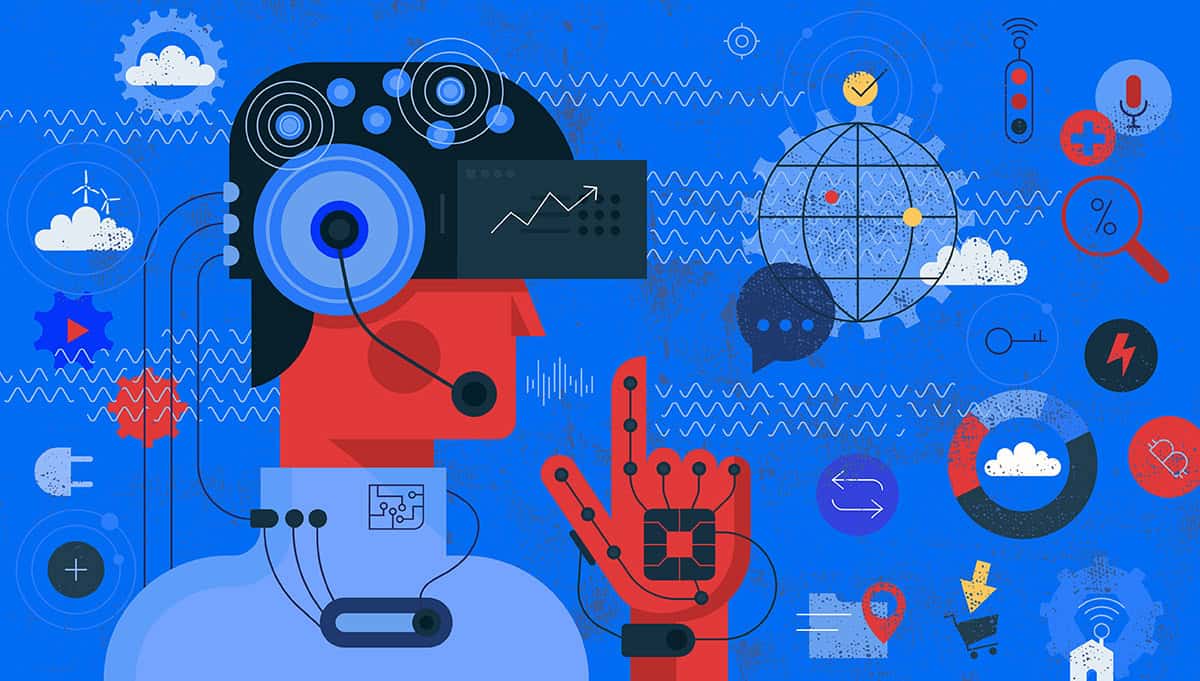
The Ultimate Chip By Howard Bloom

Once upon a time the idea of a genie in Aladdin’s lamp was a fantasy. That genie was conjured in prose sometime before 1704 in the Arabian Nights. But it couldn’t be conjured in reality. Now with the advent of AI, that fantasy is about to come true. Yes, within less than a decade we may well have the genie of Aladdin’s dreams, the device that will read your thoughts, figure out your needs before you know you have them, and fetch you the perfect girlfriend, the perfect shoulder to cry on, the perfect book, the perfect doctor, or the perfect tool.

Meanwhile, once upon a time, from roughly 1620 until this very minute, advertising was a tremendous waste of money, energy and time. To reach one person who needed your product, you had to spread your message to millions who did not need it. And you had to repeat your exposures until your name stuck. For every sale, you had to hammer millions of people who didn’t need your offering. In fact, you had to hammer those millions over and over again. Now we’re on the verge of reversing that and allowing a customer to reach out to you directly when your gizmo or service is exactly what he or she needs. It’s all coming thanks to the ultimate chip and something called an intelligent agent.
Here’s how I got into this territory. I built my first Boolean Algebra machine and co-designed my first computer when I was twelve. The computer won science fair awards. Twelve years later, I studied early neuroscience with EE Coons, the man who discovered what the hypothalamus did. I would eventually become a visiting scholar at NYU’s graduate psychology department and would publish in journals or give lectures at scholarly conferences in twelve different scientific fields from quantum physics and cosmology to evolutionary biology, and from information science to aerospace.
But around 1970, I wrote a science fiction story. In it, a man who has racked up hundreds of unpaid traffic tickets goes before a judge. The judge gives him two choices—six months in jail or participation in a scientific study. The traffic violator chooses the scientific study. So he’s implanted with a chip. A chip that monitors his thoughts and his emotions. And he’s sent an inflatable woman, a sophisticated sex toy. The experiment involves measuring his responses to his inflatable female. Naturally, he falls in love with the sex toy. Then tragedy strikes. With an accidental swipe of a broken toenail, our hero punctures his artificial her, lets the air out, and loses her forever. The relevant part of the story is not our protagonist’s tragic loss. It’s the chip. And the idea of chips like this implanted in hundreds of thousands of people so that scientists could study emotion, behavior, and the mysteries of the psyche and of the crowd in a whole new way. The harvest of insight could be huge. And privacy problems never occurred to me.

That’s how I started to conceptualize something I called the ultimate chip.
Then in the 1990s, I was stuck in bed for fifteen years with a ferocious illness—ME/CFS, myalgic encephalomyelitis/chronic fatigue syndrome. For five years I was too weak to speak and too weak to have another person in the room with me. As all the things I’d imagined for my future became impossible, I lost my sense of humanity. The only real estate in which I could travel, make new friends, and build a new identity was the Internet. I was already a technology nut. But this experience taught me about the intense emotional possibilities of the cloud.
After five years, I regained the strength to use my voice. I was still stuck in my bedroom but I could have visitors. A 30-year-old computer scientist from Boston started making pilgrimages from Massachusetts to New York to see me. Why me? My visitor had put together a set of trading cards with the world’s geniuses, people like Albert Einstein, Richard Feynman, Isaac Newton[i] and, of all people, me. The genius trading card conceiver’s name was Alexander Chislenko. He was from Russia and had moved in 1969 from Leningrad to Boston[ii] to be close to computer pioneers like Marvin Minsky. And Alex had bet his career on a field that had become radically unfashionable, something called “artificial intelligence.”

Yes, artificial intelligence had been popular in the 1980s. Then, in the 1990s, scientific fashion tossed it aside as an unproductive distraction. Yet Chislenko hung in there. He had a simple concept, simple but brilliant.
In your computer and cellphone, you’d have an intelligent agent. A piece of software that would belong to you, that would learn your needs, your excitements, your irritations, your pains, your desires, and your dreams. A piece of software that would come to know you better every day. That intelligent agent would do something remarkable for you. It would surf the cloud 24/7 bargaining with the intelligent agents of the world’s other eight billion people, snooping, hunting, poking and probing. For what? For other intelligent agents offering things that fit your needs. Or, to put it differently, checking other intelligent agents to see if their needs fit yours. And to offer the possibility of putting you together with the owner of another intelligent agent if you chose to follow up on your intelligent agent’s suggestion.
The primitive ancestors of these intelligent agents came alive in 2000. They were the product suggestion algorithms of Netflix and Amazon. But they belonged to Netflix and Amazon. Not to you. By 2012, marketers were working madly to use deep data to see your needs and to deliver the right offering to you at precisely the right moment, just when you needed it most. But there were extreme concerns about invasions of your privacy. Why? Because these harvests of data were out to read your mind. But they belonged to companies some of which were trying to prey upon you, not serve you. And, most important, because these harvests of data about you did not belong to you.
In Alexander Chislenko’s vision, these harvests would belong to you. Exclusively. Which means turning advertising on its head. To the benefit of both you and of the advertiser. Your intelligent agent and those of billions of others would come to the advertiser when you needed her goods or services. Your intelligent agents and those of billions of others would eliminate the need for advertising to hundreds of millions who did not need a company’s offerings.

It’s the opposite of a revolution that occurred in the early days of radio. In 1895, the inventors of radio were looking for a way to send telegrams without using wires. When they finally came up with a way to use radio waves, they had a problem. Telegraph lines go from one point to another. Radio waves do not. They spread out in circles. This was a huge disadvantage if you wanted to send a telegram from your home in San Francisco to your aunt Maud in London. Then someone came up with a way to turn this problem into an opportunity, to turn a disadvantage into a blessing. The new concept that turned radio’s flaw into a goldmine was called “broadcasting.” And it led to the golden age of radio, to the big three TV networks, to celebrities from Arthur Godfrey to Jimmy Kimmel, and to the nightly news.
Alexander Chislenko’s intelligent agent, the agent that belongs to you and to you alone, the agent that works tirelessly to learn you so well that it can read your mind, takes advertising from a broadcast medium back to a point to point communication.
That intelligent agent could lodge in a chip behind your right ear and could do amazing things for you. Say you are on a business trip to Detroit. You check into your hotel, drop your bags in your room, and go down to the bar hoping for human company. Sure enough there are other folks in there. But you do not know them. They have off-putting expressions on their faces. So you buy a drink, nurse it, then go back up to your room not having met a soul. Your chip and its intelligent agent would change all that. As you scanned the room, it would use facial recognition and access to the cloud to fetch the names of the folks you had looked forlornly at, to get their biographies, and to pick the ones with the interests and personalities that most fit yours. Your intelligent agent lodged in the ultimate chip would hand you the results, and would suggest opening questions with which you could approach each one—like “Hi, I hear you’re into technology. So am I.”
Then there are those mornings when you wake up, stumble to the bathroom, and are hit with a brilliant idea. The idea is so amazing, you know you will remember it long enough to write it down. But you have more urgent things to attend to. When you are finished and walk back to your room, the idea is gone. As if it never existed. Those days are over. Your ultimate chip will store your brilliant idea in the cloud. Along with all of your other spectacular brain-flashes. And when you are in the middle of a project or a conversation that those old thoughts might apply to, the intelligent agent in your chip will remind you of your past astonishing ideas in a similar vein and ask if you want them.

But that’s not all. Those speeches that you write but don’t have the time or patience to memorize? The intelligent agent in your chip will recall them and feed them to you word after word when the time comes to deliver them to an audience. You will never be tongue tied when public speaking again.
And those miserable days when your boss comes down on you like a ton of bricks? You walk out of the office at the end of the day wounded. But you’ve learned that if you tell your wife about your misery, she, too, will attack you. Yes, that’s a nasty pattern that even shows up in seagulls—attacking your fellow creatures in pain, the ones who need you most. So who can you talk to? The one being that spends more time caring about you than anyone else in the world. Your intelligent agent. Let’s call her Ashley. When you get into your car, you pour your heart out to her. She listens sympathetically. And she scouts the web to see if there’s anything that might help ease your agony. Like a job at a company that would appreciate you.
What tools will make your genie in a bottle—your intelligent agent–come to life? Your videocam, facial recognition, prosody-reading sound technologies, and your smart watch sensing your heart rate, your blood pressure, and your gsr, your galvanic skin response.
Then there’s the chip Elon Musk is developing. At a time when some neuroscience labs are still using single-electrode probes in their research, the device from Musk’s Neuralink company will have 3,072 electrodes.[iii] The short-term goal is to implant Musk’s chip in the brains of quadriplegics so those unfortunates can regain some of their abilities. But the long term goal is to enhance the powers of you and me.
***

When I first started thinking out the ultimate brain-cloud interface in 1970 and began the project I called the ultimate chip, computers were massive and expensive. So the ultimate chip was impossible. Each of the desktop computers we used in Fortran courses at NYU, where I went to school, covered the surface of a very large desk. Each computer was four feet wide, three feet deep and a foot and a half tall. We had six of these big, flat devices in one room. The machines were colored gray, but they were black boxes. The idea of hooking them to a monitor and a keyboard had not yet caught on.[iv] Much less the idea of connecting them to your brain. You communicated with these “desktops” via punch cards. In other words, you wrote a program, converted it to a two-inch high stack of punch cards, and fed the 200 punch cards one by one into the computer the way you feed your credit card into a credit card reader today. Then the Radio Shack folks and Toshiba invented the first laptop computers. And by roughly 2000,[v] those computers had microphones and videocams as standard equipment. In other words, by roughly 2000, computers had the ability to see and listen to you.
Meanwhile way back in roughly 1999,[vi] University of San Francisco psychologist Paul Ekman issued pictures of 110 Micro-expressions,[vii] quick flashes of facial expression that gave your emotions away. Expressions that a computer equipped with a webcam could use someday to feel out your inner life. Then came the iPhone in 2007 and put the power to listen to you all day long in your pocket. And the power to serve you. In 2010, Demis Hassabis founded Deep Mind Technologies and popularized the concept of Deep Learning. A form of learning that could eventually learn the innermost you. In roughly 2010[viii] computers would become good at facial recognition. And in 2017 the Israeli company Beyond Verbal introduced an Application Programming Interface that could read the emotions in your voice, a program that could read your prosody, the music of your speech, not just the words.
Finally in 2014 came Apple’s Smart Watch with sensors for your heart rate and your steps. Other wearables emerged with the ability to sense your blood pressure. These were all the tools an intelligent agent would need to read your mind and your feelings. All the tools the ultimate chip would need to learn to anticipate your needs. They are all the tools that could give you your very own intelligent agent.

If the intelligent agent and the ultimate chip ever come to be, Amazon and other online services will gladly provide the goods and services that will help you achieve your goals. But the most important needs in your life are not goods and services. They are human contacts. They are love and warmth. And your intelligent agent will be capable of putting you together with people you should meet and with people of the sex you prefer who might be ripe for relationships.
But, alas, today computer mindreading is being designed to be top down. Not bottom up. Alexander Chislenko’s personal, private intelligent agents have not yet arrived.
In 2010 I was on a panel in San Diego at Demo—an event where next-tech developers pitch their products to venture capitalists. On the panel with me was Peter Norvig, director of research for Google. I preached the genie-in-the-bottle intelligent agent to the audience. Peter preached a statistical exploration of massive amounts of data—all the data of Google plus all the data of YouTube and all the data of Google image search. Not to mention the data of Gmail. Peter preached top down exploration of deep data, very deep indeed. And very top down. And the results of that exploration of your heart and soul belonged to Google, not to you. Until 2003, Peter’s vision won out.
But there’s a lot more development of the ultimate chip to come. Will computers ever go past implantable chips and be able to read your mind without insisting that you wear special hardware? In other words, could the ultimate chip someday work without a chip? I suspect that capability is not far away.

But, more important, will the Alexander Chislenko vision, the personal intelligent agent, ever come to pass? Will the advertising model ever turn upside down from broadcasting to narrow-casting? From messages sent by advertisers to messages sent by you? Will the artificial intelligence that reads your mind ever belong to you? We shall have to see. But one way or the other, AI is on its way to achieving a simple goal: becoming your genie in a bottle. Serving your every need.
From Frank J. Boehm, Nanomedical Brain/Cloud Interface: Explorations and Implications, Bristol, UK: IOP Science, 2026.
______
About the author: Howard Bloom of the Howard Bloom Institute has been called the Einstein, Newton, Darwin, and Freud of the 21st century by Britain’s Channel 4 TV. Bloom’s new book is The Case of the Sexual Cosmos: Everything You Know About Nature is Wrong. Says Harvard’s Ellen Langer of The Case of the Sexual Cosmos, Bloom “argues that we are not savaging the earth as some would have it, but instead are growing the cosmos. A fascinating read.” One of Bloom’s eight previous books–Global Brain—was the subject of a symposium thrown by the Office of the Secretary of Defense including representatives from the State Department, the Energy Department, DARPA, IBM, and MIT. Bloom’s work has been published in The Washington Post, The Wall Street Journal, Wired, Psychology Today, and the Scientific American. Not to mention in scientific journals like Biosystems, New Ideas in Psychology, and PhysicaPlus. Says Joseph Chilton Pearce, author of Evolution’s End and The Crack in the Cosmic Egg, “I have finished Howard Bloom’s [first two] books, The Lucifer Principle and Global Brain, in that order, and am seriously awed, near overwhelmed by the magnitude of what he has done. I never expected to see, in any form, from any sector, such an accomplishment. I doubt there is a stronger intellect than Bloom’s on the planet.” For more, see http://howardbloom.net or http://howardbloom.institute
[i] Great Thinkers and Visionaries on the Net
|
[ii] http://www.lucifer.com/~sasha/home.html
[iii] https://www.dezeen.com/2019/07/22/elon-musk-neuralink-implant-ai-technology/
[iv] http://theinventors.org/library/inventors/blcomputer_keyboard.htm
[v] https://en.wikipedia.org/wiki/Webcam#Connectix_QuickCam
[vi] Ekman, P. (1999). Facial Expressions. In Dalgleish, T. & Power, M. J. (Eds.), The Handbook of Cognition and Emotion (pp. 301-320). New York, NY: John Wiley & Sons Ltd.
[vii] https://www.paulekman.com/product/pictures-of-facial-affect-pofa/
[viii] https://www.facefirst.com/blog/brief-history-of-face-recognition-software/